7 Best Smart Air Conditioner Brands for Global Buyers
Choosing a smart air conditioner for an international home is not simply a matter of comparing cooling capacity. Climate, voltage, room size, insulation, and local service access can change the buying decision. A model that performs quietly in a Singapore apartment may struggle in a dry inland region. That difference matters. Global buyers also face app restrictions, language gaps, plug standards, and uneven warranty coverage.
This guide examines seven leading smart air conditioner brands through practical criteria rather than attractive specifications alone. The comparison considers energy management, temperature accuracy, noise, installation requirements, connectivity, and after-sales support. It also asks whether a phone app remains useful when Wi-Fi fails or cloud services change. That question is easy to overlook. Independent certifications, published technical data, and regional product pages provide stronger evidence than promotional claims. Still, performance can vary between models sold under the same brand name.
Readers should treat the rankings as a starting point, not a universal verdict. A premium unit may offer excellent sensors but lack affordable replacement parts nearby. A less famous brand may deliver efficient cooling and simpler controls. That is worth considering. Real value depends on the complete ownership experience, including installation quality, cleaning, electricity use, and repair response. The right choice should cool the room reliably, protect comfort, and fit local conditions without forcing buyers to trust vague promises.
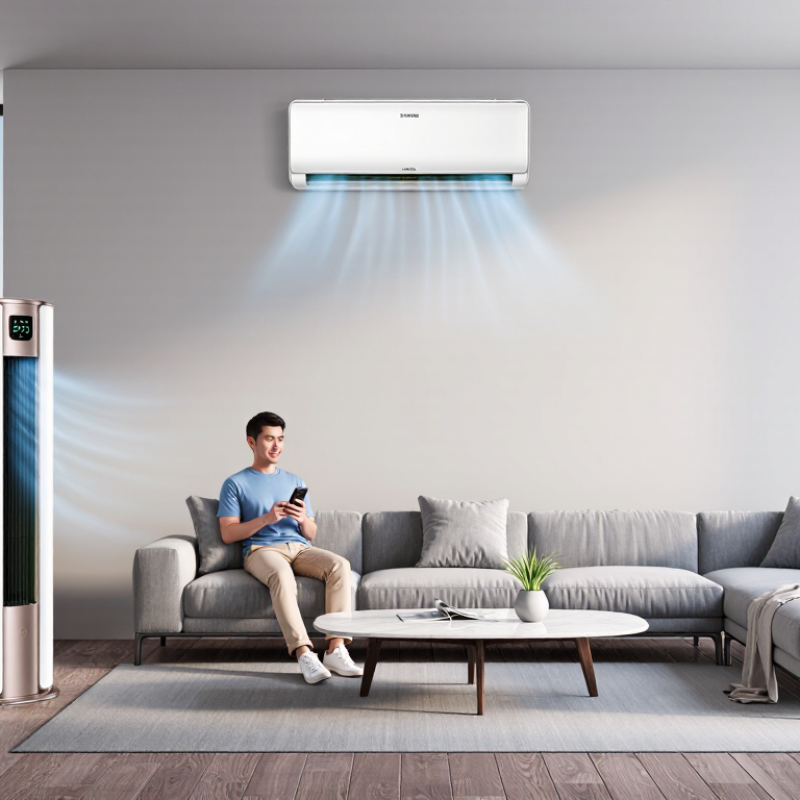
Smart Air Conditioner Technology and Key Features
7 Best Smart Air Conditioner Brands for Global Buyers
Smart Air Conditioner Technology and Key Features
Smart air conditioners now combine inverter compressors, temperature sensors, and connected controls. An inverter compressor adjusts cooling speed instead of switching fully on and off. This can reduce temperature swings and energy waste during long summer nights. In my experience, sensor placement matters more than many buyers expect. A unit near a sunny window may read the wrong room temperature. Small detail. Big difference.
Wi-Fi control lets users adjust cooling before reaching home. Geofencing can pause operation when everyone leaves. Some systems also support voice commands, sleep schedules, and energy reports. These features sound impressive, but a stable internet connection remains important. Local buttons should still work during outages. That is often overlooked. Energy monitoring can reveal whether a “smart” schedule actually saves power. Real measurements are more useful than advertising claims.
Air quality features deserve careful attention. Fine-particle filters, humidity control, and self-cleaning functions may improve comfort, but they do not replace ventilation or regular maintenance. Automatic fault alerts can identify blocked filters or unusual temperature changes. Buyers should check app privacy settings and local electrical requirements before installation. Climate, room size, voltage, noise levels, and available service support vary worldwide. One feature may perform well in a dry apartment but disappoint in a humid coastal home. The smartest choice is not always the most connected one.
7 Best Smart Air Conditioner Brands for Global Buyers - Smart Air Conditioner Technology and Key Features
| Technology Profile | Typical Cooling Capacity | Compressor Technology | Smart Connectivity | Key Smart Functions | Energy and Climate Features | Installation and Market Fit | Important Buying Check |
|---|---|---|---|---|---|---|---|
| Smart Inverter Split AC | 9,000–24,000 BTU/h | Variable-speed rotary or scroll compressor | 2.4 GHz Wi-Fi; mobile app; some models support local control | Remote scheduling, temperature monitoring, sleep mode, filter alerts, usage history | High part-load efficiency; precise temperature control; heating may be available through a reverse-cycle heat pump | Professional installation; suitable for bedrooms, offices, and living rooms in many climates | Confirm voltage, refrigerant type, regional efficiency label, and installer support |
| Smart Multi-Split System | 18,000–60,000 BTU/h total system capacity | Variable-speed outdoor compressor serving multiple indoor units | Wi-Fi gateway or built-in Wi-Fi; multi-zone app control | Independent room schedules, zone control, occupancy-based operation, fault notifications | One outdoor unit can reduce exterior equipment; zoning avoids conditioning unused rooms | Professional design and installation; suitable for apartments, villas, and small commercial spaces | Check maximum connected indoor units, pipe-length limits, and whether all zones can operate together |
| Smart Window AC | 5,000–25,000 BTU/h | Fixed-speed or inverter compressor, depending on model | Built-in Wi-Fi on selected models; app and voice-platform compatibility varies | Remote on/off, schedules, room-temperature reports, filter reminders | Efficient for single-room cooling; energy-saver modes may cycle the compressor automatically | Lower installation complexity; suitable for buildings with compatible window openings | Measure the window opening and verify local electrical load, plug type, and drainage requirements |
| Smart Portable AC | 8,000–14,000 BTU/h published capacity range | Usually fixed-speed; inverter portable models are less common | Wi-Fi on selected models; app control is generally 2.4 GHz dependent | Remote control, schedules, operating-mode selection, water-tank alerts | Easy relocation; single-hose designs can draw warm replacement air into the room | Minimal permanent installation; useful for rentals and rooms without split-system access | Compare standardized cooling ratings where available, not only the larger marketing BTU number |
| Smart Cassette AC | 18,000–60,000 BTU/h | Variable-speed compressor in advanced systems | Central controller, wired network interface, or optional Wi-Fi gateway | Four-way airflow control, schedules, zone management, error-code reporting | Even air distribution; some units include occupancy sensors and fresh-air connection options | Ceiling installation; suited to retail, offices, restaurants, and large open rooms | Verify ceiling void depth, condensate drainage, service clearance, and required controller hardware |
| Smart Ducted AC | 24,000–96,000 BTU/h | Variable-speed compressor with ducted air handler | Building-management interface, wired controller, or Wi-Fi gateway | Whole-home scheduling, zone dampers, remote diagnostics, demand-management integration | Can condition several rooms; duct design and leakage strongly affect energy performance | Permanent professional installation; suitable for new construction and whole-home projects | Request a duct-loss assessment and confirm that zoning controls are included, not optional |
| Smart Heat-Pump AC | 9,000–36,000 BTU/h | Variable-speed reversible compressor | Wi-Fi app, remote controller, and selected voice-assistant or home-automation integrations | Cooling and heating schedules, weather-aware control, vacation mode, energy monitoring | Provides both cooling and heating; cold-weather performance depends on the model and outdoor temperature | Professional installation; suitable for regions requiring year-round indoor temperature control | Check rated heating capacity at low temperatures, defrost behavior, backup heat, and local service coverage |
Related Posts
-
10 Best Tips for HVAC System Maintenance Every Homeowner Should Know
-

How Split Heating and Cooling Systems Enhance Home Comfort Year Round
-

Top 10 Benefits of Ductless Heating Systems for Buyers?
-
Top 5 Mini Split Smart Thermostats for Ultimate Energy Efficiency in 2023
-
Ductless HVAC System Tips for Optimal Home Efficiency?
-
How Do Ductless Heating and Cooling Systems Work?