Who Are the Top Fire Rated MDF Suppliers in China?
Choosing the right Fire Rated Mdf supplier in China takes more than comparing prices. Buyers need panels that match the intended use, finish, and required fire-performance criteria. A sample may look consistent, yet the full shipment can reveal differences in thickness, density, or surface quality. Small details matter.
This guide explores how to assess leading suppliers through practical, verifiable criteria. These include product specifications, available test documentation, production capacity, quality-control processes, packaging, and communication. Ask for reports that identify the tested product and its thickness; fire performance can vary between panel types and testing conditions. Confirm other project requirements too, such as moisture resistance, formaldehyde emissions, and compatibility with laminates or veneers. Requirements differ by destination and application, so verify them independently rather than relying on a sales description.
A polished brochure is not proof. Request samples, compare batch records where available, and clarify lead times before placing a large order. Supplier claims should be checked against project needs and relevant documentation. No supplier is perfect, and a low quote may leave important questions unanswered. That distinction is easy to miss. The companies worth considering are those that explain their specifications clearly, respond consistently, and provide evidence buyers can review. The comparisons ahead are intended as a starting point, not a substitute for technical checks or independent verification.
What Is Fire-Rated MDF and How Is It Classified?
What Is Fire-Rated MDF and How Is It Classified?
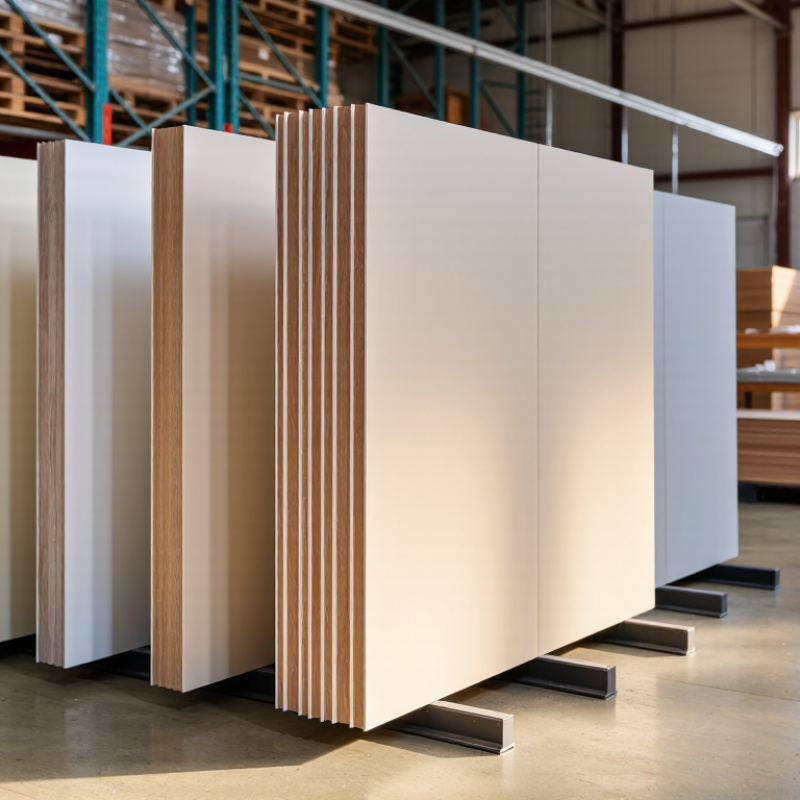
Fire-rated MDF is a wood-fibre panel treated with flame-retardant additives during manufacture. It is designed to reduce flame spread or slow fire growth under specified test conditions. It is not fireproof. Its performance depends on the panel’s composition, thickness, density, and installation details. A pale pink or red core may help identify some products, but color alone proves nothing.
Classification depends on the market and the test method. In Europe, panels may be assigned a Euroclass under EN 13501-1, based on reaction-to-fire tests. In other markets, standards such as ASTM E84 assess flame spread and smoke development. These systems are not interchangeable. Check the test report, product datasheet, and stated conditions, including thickness and mounting method. Small details matter.
A panel’s classification also does not automatically establish the fire rating of a wall, door, or ceiling assembly. Joints, fixings, gaps, and surface finishes can change the overall result. For a project, match the tested panel specification to the intended use and required local classification. If documentation is vague, ask for the exact test standard and report. That extra check is worth it.
What Standards Apply to Fire-Rated MDF in China?
For fire-rated MDF in China, check GB/T 20241-2006, the national standard for fire-retardant wood-based panels. It sets product requirements and test methods; a supplier’s sales description alone does not establish compliance. GB 8624-2012 classifies building products by reaction to fire, including A, B1, B2, and B3. The required class depends on the building’s use and the applicable design specification. Ask for the complete test report, including the tested panel thickness and surface finish. Small details matter.
Formaldehyde emissions are a separate issue. GB 18580-2017 sets an E1 limit of 0.124 mg/m³, measured using a 1 m³ chamber method. The China Academy of Building Research’s technical guidance and the cited national standards distinguish emissions testing from fire-performance testing; one result cannot substitute for the other. For interior projects, also check the project’s fire-design requirements and whether the report covers the supplied product—not merely a similar sample. Even careful buyers can miss this. I would treat an unexplained mismatch between the certificate and delivered panel as a reason to pause and verify.
Who Are the Leading Fire-Rated MDF Suppliers in China?
Leading fire-rated MDF suppliers in China are best identified by evidence, not broad claims. Look for established panel manufacturers, specialist fire-resistant board producers, and export-focused engineered-wood suppliers that can explain their testing and production controls. Ask which fire classification the board meets, which test method was used, and whether the report matches the exact thickness and product construction you plan to buy. A certificate for another panel is not enough. Details matter.
Request recent test reports, a technical data sheet, and a sample from the production batch under consideration. Check the board’s density, thickness tolerance, surface quality, and machining behavior; a clean cut edge can reveal loose fibers or uneven bonding. Also confirm how the supplier handles batch records and repeat orders. A low price may look attractive, but inconsistent performance can cost more during installation. I would not rely on a polished certificate scan alone. It is easy to overlook this, and buyers sometimes do. Independent verification is worth considering, especially when the board will be used in a safety-sensitive assembly.
Who Are the Top Fire-Rated MDF Suppliers in China? – Who Are the Leading Fire-Rated MDF Suppliers in China?
Fire performance depends on the specific board, thickness, installation, and test method. Rather than assigning unsupported supplier rankings, this table sets out verifiable criteria for comparing Chinese fire-rated MDF suppliers. Request product-specific documentation before purchase.
| Evaluation dimension | Relevant standard or specification | What to verify with the supplier |
| Fire classification in China | GB 8624-2012, Classification for burning behavior of building materials and products | The exact classification stated on the test report, and whether it applies to the offered board’s thickness and construction. |
| Fire classification for European projects | EN 13501-1 | The complete Euroclass designation and supporting test documentation. Do not assume a Chinese classification directly corresponds to a European class. |
| Fire-test evidence | Applicable test methods cited in the classification report, such as GB/T 8626 or GB/T 20284 where relevant | A complete report from a qualified testing laboratory, including the tested product, specimen thickness, test date, and result. |
| MDF product specification | GB/T 11718-2021, Medium density fibreboard | The declared grade and product data sheet, including thickness, dimensions, density, moisture content, and applicable tolerances. |
| Formaldehyde emissions | GB 18580-2017, Indoor decorating and refurbishing materials—Limit of formaldehyde emission of wood-based panels and finishing products | The declared emission result, test method, and documentation for the exact product being quoted. |
| Production consistency | Batch records and documented quality-control procedures | Whether the fire-retardant formulation and production controls are maintained across batches, with traceable batch identification. |
| Export and project suitability | Destination-market regulations and project specifications | Confirmation that the certificates, test reports, dimensions, finish, and packaging meet the requirements of the intended market and application. |
How Can Buyers Compare Chinese Fire-Rated MDF Suppliers?
Compare suppliers by evidence, not by the phrase “fire-rated.” The FAO’s Global Forest Products Facts and Figures 2022 reports worldwide wood-based panel production at roughly 400 million cubic metres. That scale makes consistent sourcing important, but it does not prove any supplier’s board will perform consistently. Ask for a current fire-classification report covering the exact MDF thickness, mounting method, joints, and end use you need. Check that the report identifies the tested product and comes from a competent testing laboratory. Paper is not performance.
Request production-batch traceability, density and thickness tolerances, and formaldehyde-emissions results alongside the fire documents. Compare quotes on matching specifications; a lower price may reflect a thinner panel or different test conditions. For European projects, ask how the stated reaction-to-fire class aligns with EN 13501-1, and verify the underlying test evidence rather than relying on a certificate image. A small sample can help check machining, edge quality, and surface consistency, but it cannot replace fire testing. I would still question vague claims such as “custom fire grade.” Suppliers may also differ in lead times and batch variation, so ask for recent inspection records and clarify what happens when a delivered lot misses agreed tolerances.
How to Compare Chinese Fire-Rated MDF Suppliers
Illustrative buyer-set weights for comparing suppliers—not measured supplier performance or market statistics.
How to use this chart: Request and verify third-party fire-test reports for the specified product and thickness, applicable classification documents, and production quality-control records. Check that the documents match the product being quoted; adapt the weights to your project requirements.
What Should Buyers Check Before Placing an Order?
Before ordering fire-rated MDF from a Chinese supplier, request the full test report, not just a certificate image. Under commonly used ASTM E84 Class A criteria, the flame-spread index is 0–25 and the smoke-developed index is no more than 450. These figures describe surface-burning performance, not a guaranteed fire-resistance duration. That distinction matters. Check that the report matches the quoted board’s thickness, density, surface finish, and installation method. A test on a coated panel may not apply to an unfinished one.
Ask whether an independent laboratory tested the product and whether its accreditation covers the method used. Confirm the report date, production site, and product identification, then compare them with the supplier’s quotation and sample. Small details count. Request batch records and a retained sample for comparison when the shipment arrives. Also check moisture content, dimensional tolerances, and formaldehyde emissions against your project’s requirements. Fire-retardant additives can affect machining and fastening, so test a cut edge and screw holding strength before approving bulk production. I would not rely on a tidy document alone; paperwork can look complete while describing a different board.