How to Choose the Best AC Tune Up Service in China?
Choosing the right ac tune up service in China matters as cooling demand grows and equipment faces long, humid summers. The International Energy Agency’s The Future of Cooling report estimated that the global stock of air conditioners could rise from 1.6 billion in 2016 to 5.6 billion by 2050. It also projected that electricity use for space cooling could more than triple. These figures describe global trends, not a guarantee about any individual Chinese home. Still, they show why careful maintenance deserves attention.
A useful service should do more than wipe the indoor unit. Ask whether technicians inspect filters, coils, drainage, electrical connections, airflow, and refrigerant performance. Look for a written checklist, clear pricing, and measurements taken before and after work. In a humid coastal apartment, a blocked drain may matter as much as a dusty filter. In a city with heavy airborne dust, coil condition deserves close attention. Details matter.
Credentials matter too. Confirm the provider’s relevant qualifications, experience with your unit type, and willingness to explain findings before recommending repairs. A dependable technician should distinguish routine cleaning from faults requiring further diagnosis. No vague promises. The IEA’s projections support the importance of cooling efficiency, but they do not prove that one tune-up will deliver a fixed energy saving. Results depend on equipment age, usage, installation, and local conditions. A tune-up is not a cure-all. I would also compare service records and follow-up policies, not just the lowest quote. Some details can still be hard to verify, so ask direct questions and keep the answers in writing.
Identify AC Type, Age, and Refrigerant Before Requesting a Tune-Up
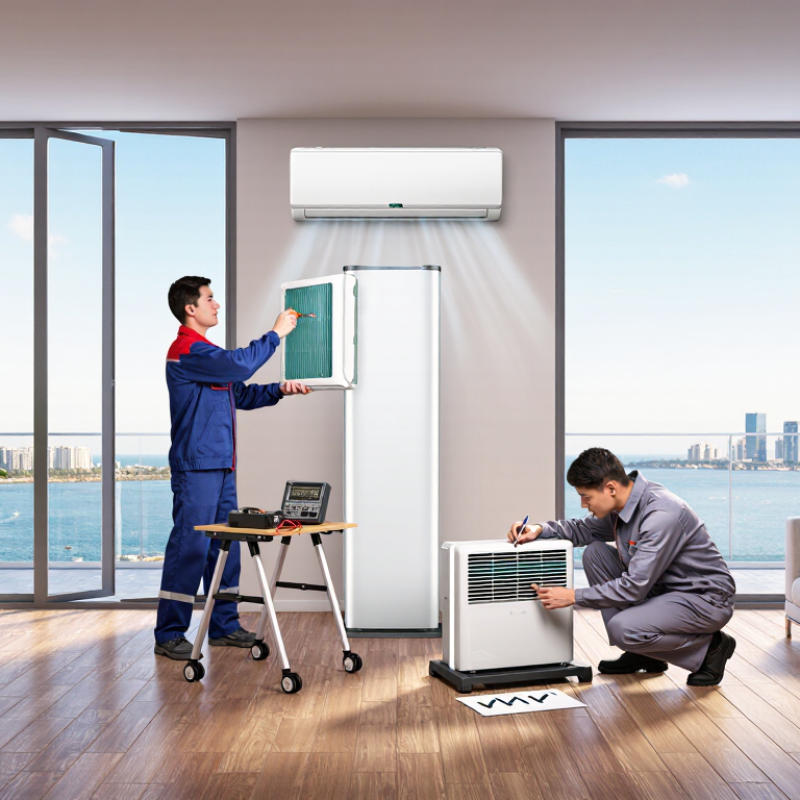
Before requesting an AC tune-up in China, note whether the system is a wall-mounted split, multi-split, ducted, or central unit. Photograph the outdoor unit’s data plate, including its model, capacity, and refrigerant marking. Also record the approximate installation year. A faded label is common. Do not guess from appearance alone.
Age and refrigerant affect what a technician should inspect and which parts or tools may be needed. Older units may use R-22; newer systems may use R-410A or R-32. The refrigerant cannot be identified reliably by the unit’s color or shape. Share clear photos and mention any past repairs, unusual noise, weak airflow, or water dripping near the indoor head.
The International Energy Agency’s 2018 report, The Future of Cooling, estimated that global AC stock could rise from 1.6 billion units in 2016 to 5.6 billion by 2050. That scale makes careful maintenance planning important. Still, age is only a clue, not a diagnosis; records can be incomplete, and I have seen labels too worn to read.
Ask the service provider to confirm the refrigerant and system type before quoting work. Request a written scope covering filter and coil checks, drainage, electrical connections, and operating temperatures. A tune-up is not automatically a refrigerant top-up. If performance has declined, ask for measurements and an explanation before approving additional work.
Check Service Procedures Against China’s GB/T 17790-2008 Installation Standard
How to Choose the Best AC Tune Up Service in China?
A dependable tune-up should include more than a quick filter rinse. Ask the technician to inspect the indoor coil, outdoor unit, drain line, electrical connections, and operating temperatures. Request a written record of readings and any recommended repairs. Clear answers matter. If the technician cannot explain a measurement, ask again.
Use GB/T 17790-2008 as a reference when the visit includes installation-related work. It addresses installation requirements for room air conditioners, not every routine maintenance task. Ask which relevant procedures the service follows, such as checking the unit’s mounting, drainage, and connected lines. A citation alone proves little; the technician should explain how the requirement applies to your home. A tune-up is not a full installation inspection.
Tips: Before booking, describe unusual sounds or leaks. Ask whether cleaning and measurements are included in the quoted fee. Keep the service record. Small details can be missed, and even a tidy checklist may not reveal every underlying fault.
Compare Inspection Items with GB/T 7725-2022 Air-Conditioner Test Methods
Choosing an AC tune-up service in China means asking what gets measured, not just what gets cleaned. GB/T 7725-2022 sets performance test methods for room air conditioners under defined conditions. A home visit cannot reproduce every laboratory condition. Still, its service record should separate measured results from visual checks.
Ask whether the technician records inlet and outlet air temperatures, airflow, and electrical input. Refrigerant pressures may be useful when technically appropriate, but they are not a diagnosis alone. The service should also cover filters, coils, drainage, wiring, and the refrigerant circuit. Compare performance claims with the standard’s test framework, and note indoor and outdoor conditions. Small details matter. The IEA’s 2018 Future of Cooling report projected global AC stock growing from about 1.6 billion units in 2016 to 5.6 billion by 2050. It also projected cooling demand could triple. That makes careful servicing more consequential. One weakness in many checklists is missing readings: a ticked box is not a diagnosis. Request values, units, and a clear note when a test could not be performed.
Interpret Energy-Saving Claims Using GB 21455-2019’s Five Efficiency Grades
When comparing an AC tune-up in China, treat GB 21455-2019 as a reference for product efficiency, not a service-quality score. The standard sets five energy-efficiency grades for covered room air conditioners. Grade 1 represents the highest efficiency, while Grade 5 is the lowest. Check the unit’s energy label and nameplate, including its model and cooling capacity, before interpreting a technician’s savings claim.
A tune-up cannot change the grade printed for a unit. It may help the AC operate closer to its intended condition by cleaning filters and coils, checking airflow, and inspecting drainage. Ask what work is included and how any claimed savings will be measured. A comparison is more credible when indoor temperature, outdoor conditions, operating time, and settings are similar. One electricity-bill comparison is weak evidence. Weather and usage can distort it.
Look for concrete findings, such as a clogged filter or restricted airflow, and request readings before and after service where practical. Be cautious if someone promises a specific percentage reduction without measurements or explanation. That distinction is easy to miss. Even a well-maintained Grade 3 unit does not become Grade 1; real consumption also depends on room size, installation, and daily use. Some estimates will still be imperfect. That is worth acknowledging.
How to Choose the Best AC Tune Up Service in China? — Interpret Energy-Saving Claims Using GB 21455-2019’s Five Efficiency Grades
The chart shows the minimum Annual Performance Factor (APF) thresholds for each efficiency grade for split air conditioners with a rated cooling capacity of 4,500 W or less. A higher APF indicates greater seasonal energy efficiency.
When assessing an AC tune-up service, ask for clear maintenance records and verifiable measurements. These grade thresholds describe an air conditioner’s rated energy efficiency; a tune-up alone does not change its certified grade. Check the applicable product label and standard requirements when comparing units.
Source: GB 21455-2019, Minimum Allowable Values of Energy Efficiency and Energy Efficiency Grades for Room Air Conditioners. Values shown are the APF thresholds for the stated cooling-capacity category.
Assess Itemized Quotes, Recorded Test Results, and Written Service Terms
How to Choose the Best AC Tune Up Service in China?
A useful quote should show what the technician plans to do, not just offer one attractive total. For an apartment split system, look for separate charges for cleaning filters and coils, checking drainage, inspecting electrical connections, and testing refrigerant performance. Ask whether transport, replacement parts, or follow-up visits cost extra. A low price can leave important work unclear. That matters.
Request recorded test results before and after service. The record might include supply-air temperature, airflow observations, drainage checks, and any error codes. In humid coastal cities, a blocked drain can cause water to drip indoors, so ask the technician to show that water flows freely. Results should identify the unit and service date. Photos can help, but they are not a substitute for measurements. A tidy report may still miss something; ask questions if the numbers seem unexplained.
Read the written service terms before booking. Confirm the expected visit length, tasks included, limits on repairs, and how additional work will be approved. Ask what happens if cooling remains weak after the tune-up, and whether the service includes a return visit. Keep the quote, test sheet, and receipt together. I may be overly cautious here, but vague promises are hard to check later. A clear agreement protects both sides.
How to Choose the Best AC Tune Up Service in China? - Assess Itemized Quotes, Recorded Test Results, and Written Service Terms
Use this 100-point worksheet to compare written offers. Record each provider’s actual quote and evidence; the weights are a comparison framework, not market prices or a guarantee of performance.
| Assessment area |
Weight |
What to verify in the itemized quote |
Evidence to request after service |
Score |
| Scope and itemization |
25 points |
Separate labor, inspection, cleaning, parts, and any optional work. Check the number and type of indoor and outdoor units covered. |
A completed checklist showing which listed tasks were performed and which were not applicable. |
____ / 25 |
| Recorded operating tests |
25 points |
Confirm the quote includes operational checks appropriate to the unit, rather than only a visual inspection or cleaning. |
A dated report with relevant readings, such as return and supply air temperatures, electrical measurements, and any applicable pressure or airflow checks. Ask for readings to be compared with the unit’s specifications and test conditions. |
____ / 25 |
| Cleaning and drainage details |
15 points |
Clarify which filters, coils, accessible drain components, and other parts are included. Check whether deep cleaning or dismantling costs extra. |
A record of areas cleaned, drainage checks performed, and any access limitations or findings. |
____ / 15 |
| Diagnosis and optional repairs |
15 points |
Require approval before extra work. The quote should explain how parts, refrigerant-related work, and additional labor will be priced if needed. |
Written findings supporting any recommended repair. Refrigerant service should be tied to diagnosis; request an explanation of leak checks where a leak is suspected. |
____ / 15 |
| Written service terms |
15 points |
Check appointment timing, access requirements, payment terms, exclusions, cancellation terms, and any workmanship or parts warranty. |
A written service record or invoice stating the work completed, parts used, outstanding issues, and applicable warranty terms. |
____ / 15 |
| Total comparison score |
100 points |
Compare the total alongside the final written price, scope, and documented evidence. A higher score does not replace checking suitability for the specific AC system. |
____ / 100 |